More than 60 Miami-Dade Fire Rescue units responded to the scene, and firefighters are working to extinguish a fire that broke out as a result of the crash, the agency said in a statement. There are “multiple patients” involved in the incident, it added.
I hope everyone is OK.
Some packages will be delayed.
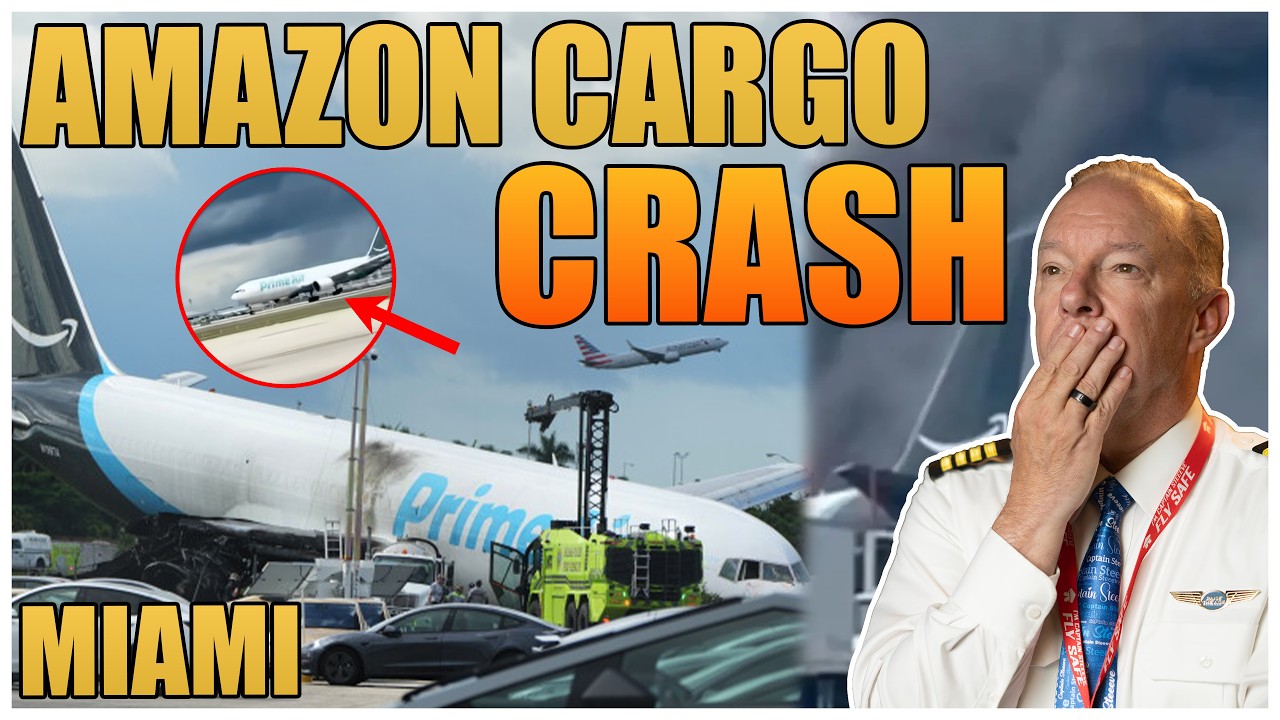
A Boeing 767-300 cargo aircraft overran the runway around 2 p.m. ET while landing in Miami, according to the Federal Aviation Administration. The plane was arriving from San Juan, Puerto Rico. The FAA identified the aircraft as a 21 Air flight. Amazon spokesperson Kelly Nantel clarified that it was an Amazon flight operated by 21 Air. The company is working to support everyone affected, Nantel added.
Thinking about @Chimanimani and @Setalpz, who both have ties to PR, iirc. Hope all are ok after the crisis is over. 
Landed too fast and set down too late, and overran the runway at MIA
Going to combine with existing thread on same subject.
Moved @ZaphodBeeblebrox post to this thread.
Ooops sorry - did not see first “thread”.
I’m sorry to say that everyone is not OK. This is Amazon. When Amazon crashes a plane, people die.
Five are dead. At least five more are injured.
As @rms noted there are 5 dead, There are some in critical condition as well. One story indicated the pilots were alive and removed from the plane.
Since they crashed through the fencing they ended up hitting a number of cars on the road and I suspect the deaths will be as a result of cars being struck and set on fire.
A news report I read said 10 people aboard with 5 dead.
I wonder why a cargo plane has 10 aboard.
This was a PR to Miami flight, pretty short. Could they be shuttling staff?
Could be staff; could just be employees catching a free flight; I would guess they have similar perks to commercial airlines.
Although TBH, I don’t know what would be a normal number on such a flight.
I predict that the forthcoming FAA investigation will find that the pilots had inadequate training.
I’ve read several possible causes put forth by posters on Facebook - brake failure, wind shear as reported by other pilots at Miami airport, and the plane landing speed was too high. I’ll wait for the experts to do their investigation.
This was rather scary for me because I flew just two weeks ago. When our 737 landed in Dallas, it seemed like a very hard landing. The plane shook from side to side as it was slowing down on the runway. I was in an aisle seat but the young man sitting next to me in the center seat gripped the arm rests as tightly as he could. We made it.
My thoughts are with those who were lost or injured in Miami.
Video shows the left rear main gear not touching down well past the half-way point of the runaway. The front and right gear touched down very far down the runway - the plane floated quite a bit without the normal flare.
I believe the 767 requires both rear main landing gears to de-tilt with a ground load before activating speed brakes and reverse thrusters. This would have prevented the speed brakes and reverse thrusters from deploying normally and closer to the initial touch-down zone with plenty of runway remaining. Weather did not look great either.
We’ll see what NTSB says, but to my untrained, non-pilot eyes this appears to be a de-stabilized approach that would have been best served by a go-around.
All my packages to PR take the USPS route these days. My condolences to everyone affected.
Various MSM News outlets are currently reporting that the NTSB has scheduled a Press Conference for 4:00 PM EDT 2026-09-07T04:00:00Z.
The 5 dead were cleaning company employees traveling in a van. At least 3 of the injured were traveling in the van.
There were two pilots on the plane and they survived.
This gives what appears to me (who doesn’t know how to fly a plane) a pretty good bit of insight into the crash. Since he spent many years flying that same airplane, and was based at that airport, I assume he has a clue about what he is talking about:
Although honestly, from my fairly ignorant viewpoint, even the first few seconds looked pretty sketchy; I know that leveling off after a flare is not optimal.
This is probably the relevant issue.
Boeing has had related problems before. Back in 1991, flight 004, a 767 owned by Lauda Airlines had a catastrophic failure. ( Yes, that Niki Lauda of racing fame )
The reverse thruster engaged at 24,0000 feet, on one engine only. The lopsided thrust tore the plane apart before the pilots could compensate. It crashed with loss of all souls on board.
In the aftermath, investigations revealed that Boeing had screwed up. They had designed a part that did not ‘fail safe’. Instead, the valve that actuated the reverse thruster could fail in such a way that the thruster became engaged.
So, in later models, Boeing included a new safety feature: the valve could not engage unless there was weight on the wheels ( In other words, only when it had touched down ).
If you look at video of the landing, you can see that the plane floats along for hundreds of feet, with the wheels mostly touching. It is effectively ‘flying’ at zero altitude. There is not sufficient weight on the wheels, so the reverse thrusters cannot be engaged. It is rapidly running out of runway.
According to most pilots who have opined on the issue, the pilot should have gone around. He still had plenty of speed. All he had to do was shove the throttles forward, lift the nose a bit, and he could go around to try another landing.
I’m going to double down on my previous prediction:
Thanks for posting this. It helps all of us understand what happened, and hope this experience will be avoided in the future.
From AP News:
Despite regulations requiring it, an air traffic controller failed to tell the pilots of an Amazon cargo plane about the potential for strong tail winds as they landed in Miami, careening off the runway and killing five people last month, according to a preliminary report Thursday from the National Transportation Safety Board.
Just four minutes before clearing the plane for landing, an air traffic controller had provided a wind advisory to a different flight, noting gusts of up to 25 mph (40 kph) from the south. But the controller “did not issue information about the wind” to the pilots of the Amazon cargo plane, the report said.
According to federal regulations, “both wind direction and velocity were required to be stated when authorizing use of a runway when a tail wind component exists,” the NTSB report said.
The preliminary report did not list a cause of the crash. The ongoing investigation could take more than a year to complete.